


I’ve enjoyed a quiet few weeks to give my ankle the time it needs to heal, and to evaluate how my journey will continue.
I’m fortunate to have stayed with family in South Africa since leaving Namibia a few weeks ago. On my way here I took a bus to Gabarone, Botswana with my moon-booted ankle, and crutches, to stay for a week and have a look around. There’s something special about Botswana. I got a sense that the city was orderly, and a bit sleepy. I learned that the country’s economy has had one of the highest rates of growth in the world for years.
It’s still early days for Botswana. Their people and politics have been relatively stable throughout their history, and their population is still as low as 2.5 million. I even went to speak with some folks at the Botswana Investment & Trade Centre, and I got the sense that open regulations and plentiful opportunities could make Botswana a fun prospect for willing entrepreneurs. It also felt like I was there before the party began - I love that feeling.
I happened to make a friend there who was thrilled at the prospects for business in Africa. As he put it, “In 1800, England was the place to be. In 1900, it was America. In 2000, China. Now, Africa is the place to be”.
Nairobi
I picked up some exciting new plans, along with motorcycle parts that are much cheaper here in SA than in Namibia. I’m going to Nairobi tonight.
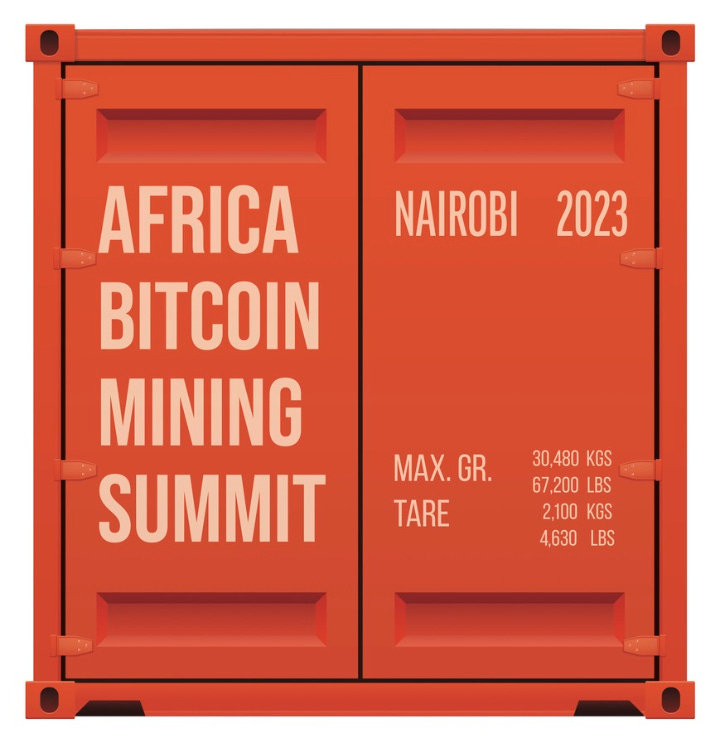
What’s in Nairobi? A conference (summit) for African Bitcoin miners is what. I was fortunate enough to receive an invitation where I’ll be on the floor amongst active players in the industry. It’s still a small community, and I’m eager to learn as much as I can.
For anyone who saw my previous post, you’ll know how unique the win-win-win dynamic amongst miners, electricity consumers, and micro-grid operators is. Above and beyond the excitement of jumping on an untapped market, it’s for a great cause.
Decentralized micro energy grids, built on renewable energy, are being incentivized by BTC miners to provide self-contained energy systems to people in geographically isolated areas. For locals, access to affordable electricity, lifestyle independence, and, therefore, increased standards of living, is the type of empowerment I like to see.
This way, everyone can live on their own terms - no central planning and no extrinsic interests.
I firmly believe that people, especially the most impoverished, typically exploit the environment out of desperation. As the theory goes, if people don’t struggle to meet their needs, then they’re given the opportunity to think long-term. Wasteful practices, like slash-and-burn, palm-oil plantations, and general deforestation benefit people today, but clearly at a great expense that isn’t sustainable.
Such is the power (electrical and otherwise) of decentralizing infrastructure amongst people. Individuals and their communities are given the ability to determine their own destinies. The miners generate revenue to help micro-grids get up and running and continue to do so until locals can meet the full demand of the grid. Once that happens, the miners simply move on to help the next community. What’s left is a grid tailored to the needs of the community, and can even be owned and operated by them, too.
Bitcoin is an odd technology. Private property rights, sovereignty of the individual, and a core ethos of freedom are so baked into the technology that the spill-off effects seem to compound. The creation of this money, Bitcoin mining, itself is turning the nature of energy markets on their head. This is without the context of what Bitcoin as a novel payment network will do to (banks and governments) the rest of the world’s markets.
I’ll be sure to report back on the insights I gain from the conference. Wish me luck.
Also, I recently went through an online course offered by leading micro-grid researchers at the University of Alaska Fairbanks on how micro-grids work, and how they’re growing in popularity and changing the way we think about electrification. It’s not too technical, but has been very helpful for someone like myself without an engineering background. Highly recommended. Link here.
An article
Since I’ve been ranting all about Bitcoin, I thought I would share an article I recently wrote for a client about “The Fiat Collapse”. Do check out their website if you’re into preserving your privacy online.
The Fiat Collapse
Bitcoin’s success implies a collapse in the role fiat currencies have played in the world. What is the timeline for this to happen, and what does a post-fiat world look like?
And why will there be a collapse? This article draws on historical evidence and basic praxeology to clarify fiat’s fragility.
We will delve into fiat’s decline in light of three phases that outline the concept of hyperbitcoinization. We will also imagine a reality of the world that has reached equilibrium on a sound money standard.
Today’s governments have misaligned their fiscal/monetary promises for far too long. They have proven that absolute monetary control incentivizes mismanagement of the money supply. With each ballooning of M2, humanity is beleaguered by years, decades, or more.
This clandestine act of wealth expropriation through inflation is a criminal one, a sinister trick not lost on the growing awareness of the public. The days are numbered for the rent-seeking, money-printing cantillionaires of the world.
The public is in need of tools to restore balance to authority, and establish an economic model based on sound logic. Bitcoin is fundamental to this cause, and when it displaces, or rather, clarifies, the role of fiat currency, then the common man, as well as governments, will be reminded that governing structures exist to serve the people, not the other way around.
The inevitability of the collapse
Even absent today's global state-of-affairs and the remarkable solutions Bitcoin provides, historical evidence suggests that the failure of any fiat currency is the norm.
The Chinese are often credited with creating the first fiat currency as early as the 12 century - near the height of the Mongol Empire. A quick internet search reveals that hundreds have existed since - rarely with a lifespan longer than 50 years.
Fiat is an attractive tool for a government. They can use it to print revenues into existence as they please, effectively borrowing wealth from the future for the purposes of today. Commodity money (like gold or silver) doesn’t offer this option.
However, it is all too easy for this printing to get out of hand. Left unchecked, hyperinflation is a real, and historically inevitable, outcome on a fiat standard.
The overwhelming majority of failed fiat currencies succumbed to hyperinflation. Looking at the rapid rates of monetary debasement in the US and beyond, it's clear that contemporary fiats are falling prey to the same predator.
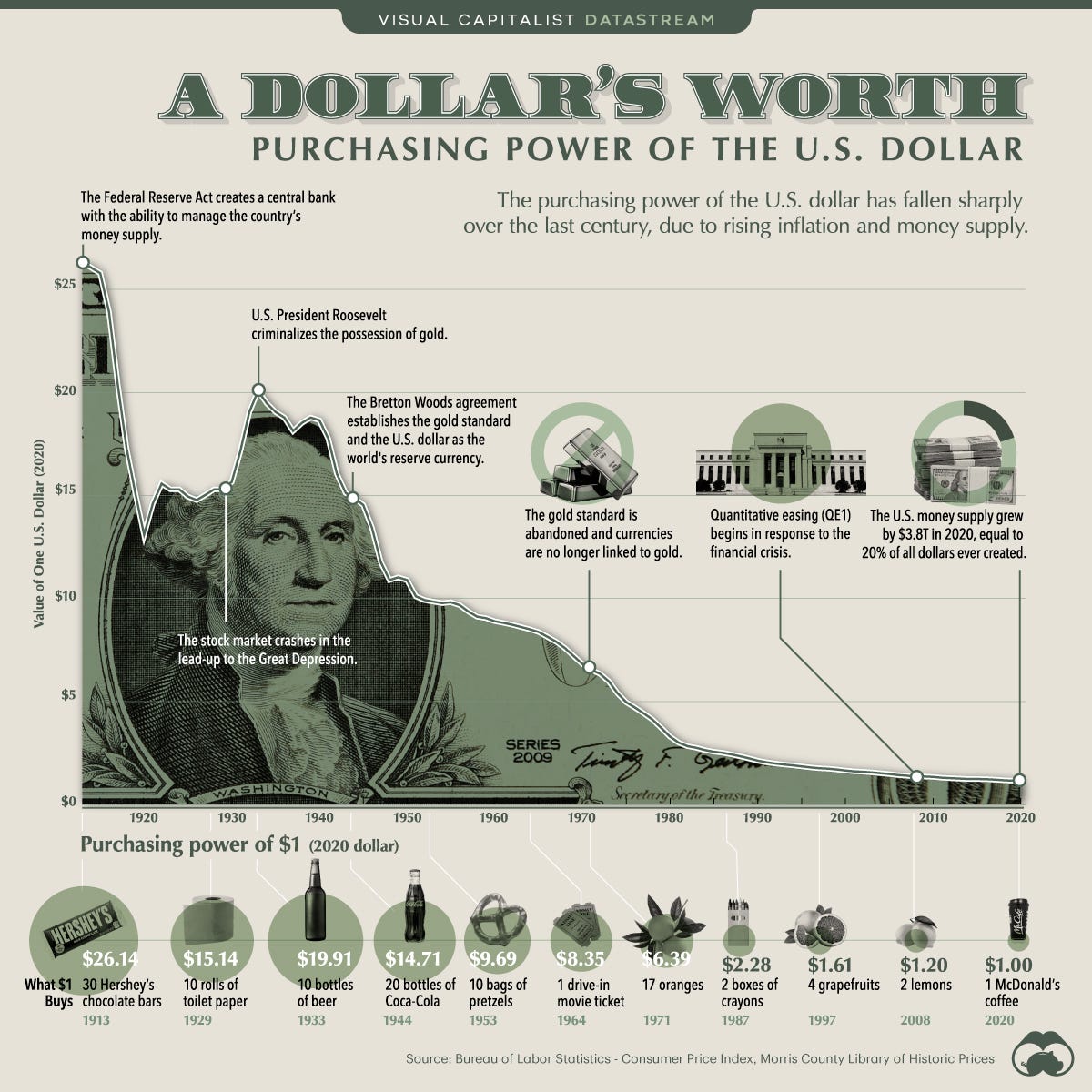
(The buying-power of our global reserve (fiat) currency, USD, has collapsed by more than 90% since over its lifetime. Source: Visual Capitalist)
We are at a unique point in history where, unlike gold or silver, a hard money exists that is impervious to the whims of authority. We are at a juncture where humanity need not be vulnerable to the wealth-destroying boom and bust cycles inherent to fiat economic backwardness.
This time, while fiat currencies take their natural course toward collapse, Bitcoin will remain as a new way forward. Therefore, to anticipate the demise of fiat, we need to understand how Bitcoin will ascend.
Phases of the collapse
Phase 1: Bitcoin as a store of value
Bitcoin is a radical new technology whose adoption starts at the grassroots level. More often than not, radical ideas take time to gather momentum—and in Bitcoin’s case, time to gather value.
Today, about 14 years later, we can confidently observe that Bitcoin, as a recognized commodity, has demonstrated the ability to store value, thus fulfilling a critical early stage of the hyperbitcoinization concept.
Phase 2: Nation-state adoption
As a proven apolitical store of value, Bitcoin is poised as a wealth haven in times of economic and political turbulence. In the midst of growing geopolitical tension, our second phase predicts that larger swaths of people and nations will flee into Bitcoin.
Bitcoin on the balance sheets of governments, and an influx of nations declaring Bitcoin as legal tender, are indications of having reached this phase.
We are on the precipice of this phase today as El Salvador continues to prosper on the Bitcoin standard, and state Bitcoin mining operations are under way in Bhutan, the UAE, and Oman.
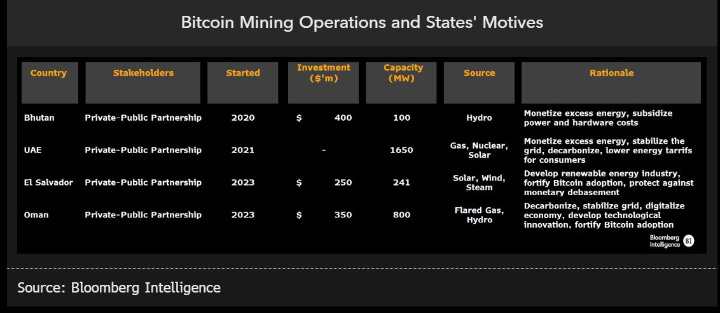
(A table of state-level activity in the Bitcoin mining industry
Source: Bloomberg Intelligence)
Phase 3: The dawn of hyperbitcoinization
Hyperbitcoinization does not imply that fiat currencies will have disappeared, but that Bitcoin has become the dominant money.
We’ll assume this means that Bitcoin has become established among some critical mass of the global population. Let’s say that means 50% of the world is willing to accept Bitcoin as a means of value.
A rough estimation is that the current global adoption of Bitcoin is at 1%. Keep in mind that Bitcoin is a technology that behaves much like the internet, meaning it can (and has) grow at much the same rate. The graph below indicates that Bitcoin’s level of adoption today is similar to that of the TCP/IP protocol of the internet in 1998.
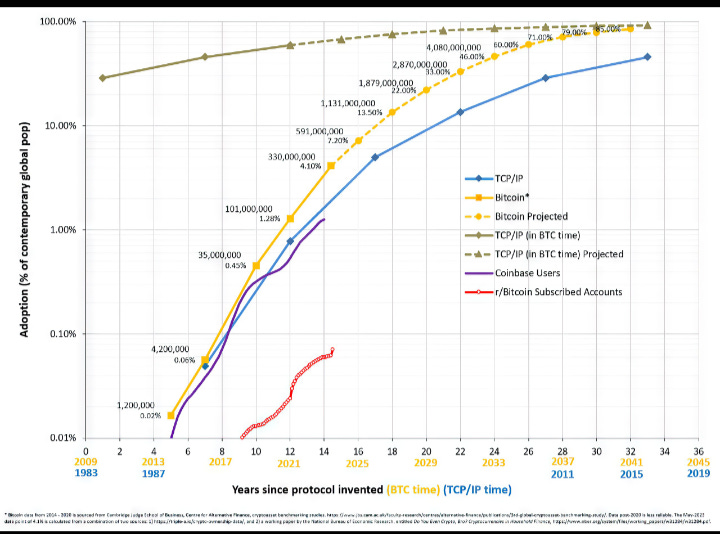
(Rate of Bitcoin adoption in relationship to the internet’s TCP/IP protocol.
Source: Vivek)
This is perhaps the most important step in the timeline of our story here, but it will take time to repair the damage left by the fiat standard.
Shifting away from the scarcity mindset of fiat economics will likely take some time for people to fully embrace. Patience is required for the seeds of freedom and financial inclusion to bear fruit on the world.
The enduring reality of fiat
Post hyperbitcoinization, fiat currencies will likely remain an enduring instrument of power to the extent that ruling nations continue to exist.
Fiat currency is going through a dark evolution today. CBDCs, AI, and the trend toward cashless societies are allowing governments to contain the behavior of "their" populations. As their relevance descends, they will likely resort to ever more extreme measures to retain a grip on power.
Manipulable money empowers governments to exert their will over others. For people especially slow to the freedom Bitcoin offers, they run the risk of becoming entrenched beneath the ever-evolving surveillance that CBDCs and misaligned AI can allow.
Toward a new global monetary equilibrium
The dawn of hyperbitcoinization will look much different than when it has reached equilibrium.
In a hyperbitcoinized equilibrium, as governments shrink to a size that is minimally necessary, I suspect professional politicians will have become relatively obsolete and that national boundaries will be much more permeable.
With the ability to store wealth without the curse of inflation or the risk of capital controls, Earth’s ecosystems will likely gain respite from people forced to exploit natural resources to make ends meet.
And as our environment blossoms, so would the quality and abundance of our food and water. The very idea of saving to provide for yourself and others would be a foregone conclusion.
As a natural phenomenon, wealth inequality would still exist, but the ability to escape poverty would be well within anyone’s reach.
What would it look like, when living in a state of mental and physical well-being is reasonably accessible for everyone? What would it look like, when providing for yourself and others is accepted as a given? How much less time would be spent on hoarding money? How much more time would be spent connecting with others, cultivating community, and spending time with family?
As innately curious and social creatures, wouldn’t we gravitate toward exploring our creativity in pursuit of art and innovation as our natural behavior?
I don’t know what the world would look like if humanity stopped shooting itself in the foot. I suppose that reality will look different for everybody. What would you do if you had all your basic needs met? What would you do if you had the time and resources to explore life as you please?
What would I do? I would celebrate. The first thing I would do is throw party after party and cross a few things off my bucket list. However, I understand that a basic quality of being human is that a life of meaning doesn’t come from a life of leisure. It would not be long before I felt the need to be productive with my time, to help others, and make the world around me a better place. Imagine a world where everyone was doing that.
The rise of the individual
Humanity has been stuck in a repeating cycle of civilization chopped off at the knees by money that allows those in power to strip the wealth of the common man. Thankfully, humanity is waking up to a new reality borne from the galvanization of the sovereignty of the individual.
For the first time in history, fiat can no longer contain us. It is up to us to decide our future, and not the governments. Fiat will collapse, and so will the idea of government to the extent that governance is truly necessary.
.
.
.
G